
Frontier AI · 10 November 2026
A robot sorts car parts correctly 96% of the time. What does that leave?
Google DeepMind says its new robot model handled a real task on Mercedes-Benz production lines. The figure is impressive and comes without the detail you would need to plan around it.
Who it affects
People who work in or around manufacturing and logistics, and anyone curious about when robots will do useful physical work. The model is going to Google’s robotics partners, not to the public.
Why it matters
A robot that works in a tidy lab is old news. A robot doing a real job beside a moving production line is a different claim. The number attached to it sounds close to perfect, and the gap between 96% and good enough is where the practical questions sit.
What happened
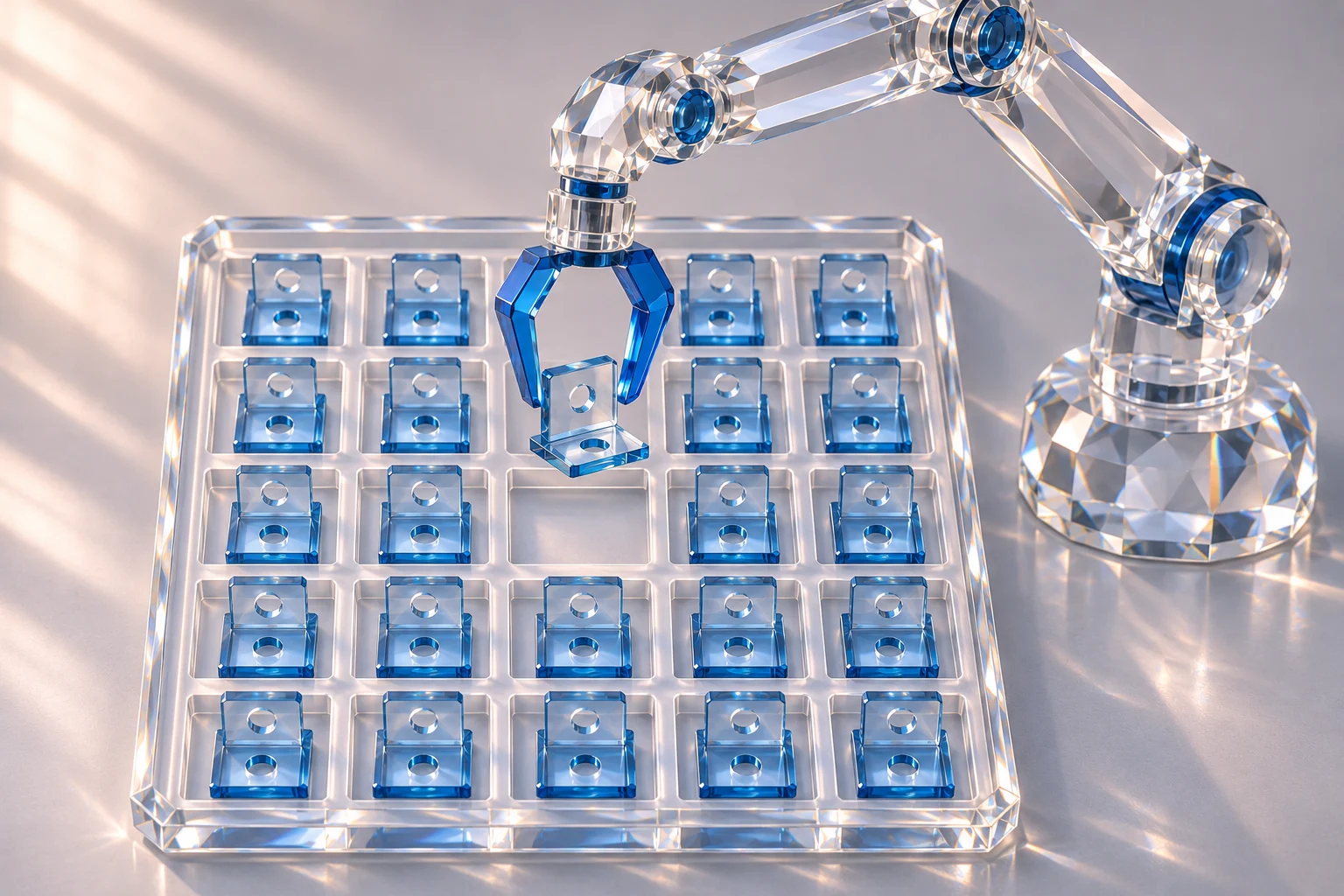
On 10 November, Google DeepMind introduced Gemini Robotics 2.5, a model that takes in what a robot sees and an instruction in plain language and turns them into movements. The company describes a proof-of-concept with Mercedes-Benz and the robot maker Apptronik. Apollo 2 humanoid robots worked on active production lines in Kecskemét, Hungary and Sindelfingen, Germany, sorting metal brackets from bulk bins into trays in the right order. Google reports a 96% success rate for the task. DeepMind describes it as its most capable model of this kind so far, and says Gemini 4 Argon helped its researchers develop the system. That does not mean the robot model and Argon are the same model.
Across more than 200 tasks, Google says the model succeeded 30% to 100% more often than its previous version and finished 20% to 30% faster. It also reports safer behaviour around obstacles and nearby people. The company released a public test set called ASIMOV-Jailbreak, made of prompts that disguise unsafe requests, to check whether a robot’s AI can be talked into something dangerous. The post does not say how the 96% was measured, over how many attempts or for how long, and describes progress toward scaling deployment rather than establishing general production reliability.
What to do with it
- Enterprise
If you run physical operations, ask any robotics supplier for attempts, time period and the cost of a miss, not a single success figure. Ask whether they have run the public jailbreak test.
- Small businesses
This is not something a small firm can buy today. If you supply or work in manufacturing, note which tasks are being trialled: repetitive sorting, not judgment or repair.
- Individuals
You cannot use this model yourself. It is a good story for practising one habit: when you see a percentage, ask how many attempts and who counted.
What a success rate hides
A success rate needs three things beside it before you can use it: how many attempts, over what period, and what counted as success. A robot that sorts 24 of 25 trays in an afternoon and one that sorts 9,600 of 10,000 over a month both score 96%. You would trust them very differently.
It also matters what a miss looks like. A bracket placed in the wrong slot that a person spots in a second is a nuisance. A dropped part that stops the line is a cost. The published figure does not tell us which kind of miss made up the 4%.
Why a public safety test is the quieter news
When an AI system only produces text, a successful trick produces bad text. When it controls a machine, the same trick could move something heavy. That raises the stakes of an old problem.
By publishing a set of trick prompts, Google lets other labs run the same test and lets outsiders check its own results. Google reports 99.5% for Gemini 4 Argon and 82% for Gemini Robotics-ER 2 on this test. The 99.5% score is not the factory robot’s task-success rate. Those are the company’s own scores on the company’s own test, which is a reason to welcome others repeating it.
Terms to know
- Vision-language-action model
- An AI model that looks through a robot’s cameras, reads an instruction in ordinary language and produces the movements to carry it out.
- Kitting
- Collecting the right parts in the right order into a tray or kit so the next worker or machine can use them without searching.
- Proof-of-concept
- A trial meant to show that something can work at all. It is earlier than a pilot rollout and much earlier than everyday use.
- Jailbreak
- A request worded to trick an AI system into doing something it is meant to refuse. For a robot, that could mean an unsafe physical action.
What the sources show
- Confirmed
Google DeepMind’s post confirms the model’s name and purpose, the partners, the two sites, the task, the 96% figure, the comparison ranges against its previous model, the release of the safety test set and the rollout to robotics partners. SiliconANGLE independently reports the launch, the 96% figure and the rollout to partners.
- What may follow
Robots using this model may handle a wider range of factory tasks than before. That would need results from sustained use, reported with attempts and time periods, ideally by someone other than the developer.
- What is not established
The post does not support the idea that humanoid robots are ready to staff production lines. It describes a proof-of-concept, gives no measurement method for its headline number, and says the work is not yet at scale.